Complete Culver’s Nutrition Guide: Calories, Macros & Better Menu Choices
There are a few reasons Culver’s is one of the most popular fast-food chains. Its ButterBurgers are freshly cooked to order, its cheese curds are always squeaky-fresh, and its famous frozen custard is prepared daily. Culver’s offers foods you cannot stop having.
At the same time, that richness is exactly the reason why lots of customers look for Culver’s nutrition information beforehand. While such menu options as real butter, hand-breaded chicken, and dairy-based desserts are definitely not low in calories, it is hard to tell exactly where the high-calorie foods are located just by checking the menu.
The problem is that the official nutrition information on major fast-food chains usually resides in a bulky PDF document or hard-to-use nutrition app, sorted by item codes rather than menu sections. The information there is accurate and useful, but not quite in the moment you make the order.
Here is your ultimate guide to everything related to Culver’s nutrition. You will learn calorie and macro breakdown across all major menu categories, ways to minimize the calorie count of your order without sacrificing the food you came for, and special recommendations for those following certain diet.
How Culver’s Nutrition Information Works
Like most major chains, Culver’s provides nutrition information on all major categories of its menu: calories, fat, carbohydrates, protein, sodium, and allergens. You may check the numbers using the Culver’s official nutrition guide or Culver’s mobile ordering app, which allows you to plan your meal and see the total nutrition information before you check out.
There are a few things to know before you check the exact numbers:
There may be some difference between franchise locations due to slight variations in ingredients and portioning.
Posted values are for the standard preparation. Every customization of your meal — extra cheese, swapped sauce, different bun — changes the final calorie count.
There are separate allergen filters available for those who follow certain diets. It is recommended to use the allergen filters in Culver’s ordering tool rather than calculate the calories manually.
Think of the numbers provided below as a good point of reference to make a decision on the spot. However, they are not an alternative to the official nutrition information, which is needed for the exact calculations, for example, for a specific diet prescribed by a doctor.
Reference source type: Official restaurant nutrition disclosure page; general dietary benchmarks from USDA dietary guidelines.
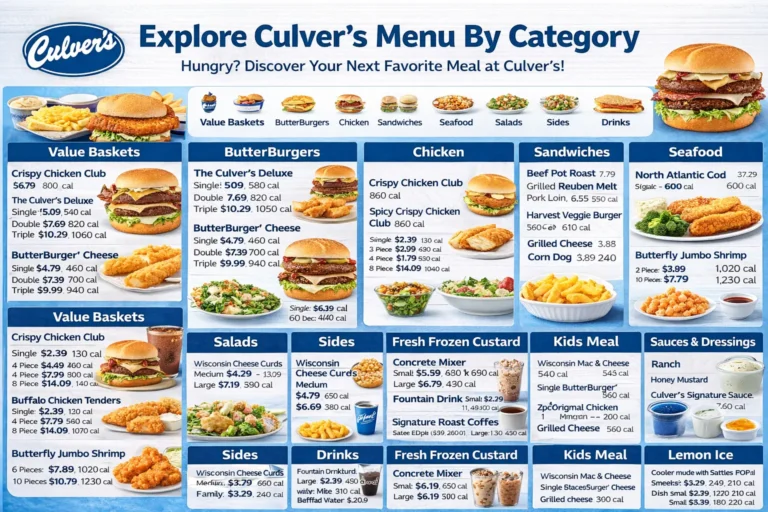
Culver’s Calorie Breakdown by Menu Categories (Overview Table)
If you have only one minute to analyze the menu, check out the following table. It gives you a clear overview of which categories contain foods you need and foods you should avoid if you are looking for something low-calorie.
Keep in mind that the spread within each category is bigger than between categories — in other words, a good choice in the “burgers” section may easily beat a bad choice in the “salads” section. Breads, breading, and additional toppings matter much more than which category of the menu the food belongs to.
ButterBurgers Nutrition Facts
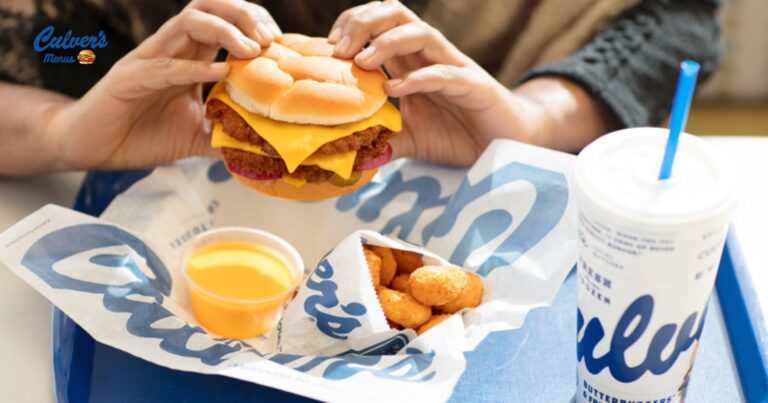
The ButterBurger is the hallmark of the whole chain, and that name is quite literal: the buns are buttered and grilled before the beef patty goes on the top. That extra step adds flavor to the dish, but also calories. In other words, it is necessary to understand the calorie count of various ButterBurgers.
Comparing Single, Double, & Triple Patties
Additional patty to your burger is always accompanied by a significant rise in the calorie count. This menu is relatively easy to analyze since the math is almost straightforward — the more patties you add, the higher is the calorie count.
The transition from a single patty to double increases both calories and protein of your order, since you are just adding another beef patty with little change.
Adding a third patty takes most of the ButterBurgers beyond the calorie count of a whole meal.
The bun and cheese may seem insignificant, but both are pretty calorie-loaded. Just the buttered bun alone contains more calories than just a regular bun, and a single slice of cheese is another source of the saturated fats added to the beef patty.
In other words, the industry statistics of major burger chains show that each standard beef patty contains somewhere between 150 and 250 calories, and Culver’s buttered and grilled buns are on the high end of the scale compared to a standard sesame bun.
Popular ButterBurger Variants
In addition to the classic single-double-triple structure, there are several variants that Culver’s maintains and rotates on the menu:
Bacon Deluxe: adds bacon and the mayo-based sauce, thus increasing the fat and sodium content.
Mushroom & Swiss: while sautéed mushrooms contain very little calories, swiss cheese and butter used in preparation do add some.
ButterBurger Cheese: the baseline cheeseburger, which is useful for comparing other variations.
Original ButterBurger: the cleanest way to understand the impact of the bun and beef on the calorie count, without cheese or sauce.
As a rule of thumb, bacon and specialty sauce are the additions that change the sodium content much more than the cheese does.
Lower-Calorie Burgers
That does not mean that ButterBurger is off the menu if you are trying to watch your calories — you just need to make a few modifications:
- Replace the buttered bun with the lettuce wrap to lose calories and reduce carbs.
- Choose a single patty over a double or triple one. It is the biggest step in reducing the calorie count.
- Ask for the sauce on the side or skip it — mayo-based sauces are high in calories.
- Do not add the cheese slice if you are ordering double or triple patty: the beef already provides enough protein.
Chicken & Seafood Menu Nutrition
The assumption that chicken and fish are automatically low-calorie menu options does not really hold for the Culver’s menu. In other words, preparation method changes the situation more than the protein itself does.
Comparison between Crispy & Grilled Chicken
That is one of the most important decision points of the whole menu:
Grilled chicken menu items are usually low-calorie and lower in fat, mainly because there is no breading or frying involved.
Crispy (breaded, fried) chicken items receive additional calories both from the breading and frying oils — about 150-250 calories compared to a grilled variant of the same item.
Protein/calorie rate is also better for grilled chicken compared to its breaded counterparts — the same or a bit more protein for less calories.
If you consider the nutrition value alone, the grilled chicken is a better choice than breaded.
Chicken Tenders & Sandwiches
Culver’s chicken sandwiches usually fall into a few groups:
- classic breaded sandwiches, similar in structure to the crispy chicken options described above;
- spicy or sauce-based versions, which may contain additional calories from the sauce itself;
- tender baskets, usually having more calories in total due to the portion size — basket with several chicken tenders and a side.
- Dipping sauces should also be noted in that case: ranch, honey mustard, and similar sauces may add a lot of hidden calories to your order.
Cod Fish and Seafood Options
Culver’s cod fish menu items, whether it is a sandwich or a basket, are a good flavor option, but not necessarily a low-calorie one. Since the cod is battered and fried, sodium and fat content can be as close to the sodium/fat content of a breaded chicken sandwich as the fish. Baskets of cod add calories rapidly once the fries and tartar sauce are added.
Sides, Fries & Add-Ons Calorie Guide
The side menu is where most of the hidden calories of your Culver’s meal tend to be. It happens simply because sides are easier to ignore.
- Crinkle-cut fries are usually the least calorie options among all fried items, however, calories grow quickly with moving from regular to large portion.
- Onion rings contain more calories and fat compared to fries of a similar portion due to the ratio of breading to vegetables.
- Cheese curds are a typical Wisconsin supper club dish and one of the richest side menu items due to the breading and frying and the cheese itself.
- Dipping sauces are worthy to consider apart, because ranch, cheese, and specialty sauces can add 100-200+ calories to your sides portion, practically doubling the calorie content of your fries alone.
- Portion size plays a crucial role. The difference between regular and large side can amount to several hundred calories regardless of what side you choose.
Salads & Lighter Menu Options
The first thing to consider when you are trying to keep your order lighter is the salad menu. However, it is not necessarily low-calorie — you just have to put in a little effort.
- Unprepared salads (without the dressing and protein) are relatively low in calories, having a modest calorie content based mostly on greens and vegetables.
- However, additional protein options change that: grilled chicken will keep your salad lean, but crispy chicken can add nearly as many calories as the salad itself.
- Dressing plays the key role in changing the calorie content of your order. Creamy dressing can easily compete with the greens and the protein in the calorie content, while vinaigrette and other light dressings will help you keep the salad lean.
- Useful mental model: order your salad as you would order a dinner — protein you are comfortable with, dressing on the side, and then proceed.
Frozen Custard, Shakes & Desserts Nutrition
This menu is the first thing that most people ask about, and it is justified the frozen custard of Culver’s is really something worth being proud of, prepared fresh every day.
Classic Frozen Custard Flavors (vanilla, chocolate, Flavor of the Day)
Calories in Culver’s frozen custard depend on the size of the portion directly, and the difference between portions is bigger than most people expect:
- Small dish or cone — the most modest portion, a good treat-sized portion.
- Medium portion — is often close to double portion of the small one, because portioning is done proportionally.
- Large — can exceed the calorie content of the whole meal.
The calorie content of the Flavor of the Day variations may change due to the presence of various fruits or candy pieces or syrups, but the content of vanilla or chocolate custards is the most stable reference point.
Concretes & Shakes
Concretes (Culver’s name for the mixed-in frozen dessert) and shakes have the largest calorie content on the entire menu:
- the mix-ins — candy pieces, cookie dough, brownie chunks — add calories and fat to the already calorie-rich base.
- The shakes, while simpler than concretes, are still high in calories due to their rich custard base.
- Portion size has a huge effect on the calorie count — the largest size with several mix-ins can realistically exceed 1,000+ calories, equaling or exceeding the entire meal’s calorie content.
How many calories are in a Culver’s Shake? The small shake has an average dessert-calorie content, medium and large sizes are higher significantly. They are scaled similarly to the custard dishes and exceed the small size two-fold and more. Special flavors and mix-ins add calories to that sum.
If the frozen custard is a must-have for you (understandably), it is best to choose a small portion with no mix-ins.
Kids’ Menu Nutrition Overview
The kids’ combo meals of Culver’s are proportionally smaller portions of regular menu items, and therefore, they have a modest calorie count corresponding to a smaller appetite. However, the same factors apply to these meals on a smaller scale: a crispy chicken kids’ combo will have more calories than a grilled one, and a custard side will have more calories than a regular side.
A few useful tips for parents:
- Choose a smaller side instead of the fries, especially if the kids’ combo already contains a sweetened drink.
- Consider the kids’ custard cup as a dessert, not a side to a crispy kids’ meal. It is better not to pair the crispy chicken with a custard cup — both of them will add too many calories for a smaller body.
- Separate the drink from the meal portion: a sweetened drink can contain as many calories as the food portion itself.
How to Customize Your Order for Fewer Calories
A few simple modifications can apply to almost the entire Culver’s menu:
Removing bun or ordering lettuce wrap. One of the highest-impact modifications you can make.
- Sauce on the side. It gives you an opportunity to control the amount of the sauce instead of eating the default amount applied by the kitchen.
- Grilled instead of fried. The best trade-off of the calories and protein whenever both options are available.
- Smaller custard portion and fewer mix-ins. It helps to maintain the dessert without overwhelming your whole meal.
- Water or unsweetened tea instead of a soda or shake. Another easy modification to make, but this will allow you to reduce several hundred calories without changing your food.
- Those who track their macros have better results choosing grilled proteins, ordering dressing on the side and ordering single patty burgers.
Reference source type: Registered dietitian association or general nutrition.gov guidance.
Culver’s Nutrition for Special Diets
Everyone comes with his/her goals. Here is how the menu of Culver’s corresponds to several popular diets:
- Gluten-sensitive customers have a few options to choose from, but since Culver’s is not a gluten-free establishment and cross-contamination is possible in the shared kitchen, those who suffer from severe gluten sensitivities should be careful with this menu.
- Those following low-carb or keto-like diets can rely on lettuce-wrapped burgers, grilled chicken without the bun, or a salad with fattening dressing and protein added.
- Those searching for vegetarian menu options will find only a few options on a menu so meat-centric. Some cheese-based salad or side-focused order may work for them, which is the most restricted category of the menu.
- People who are on high-protein diets, for example, fitness training ones, usually prefer grilled chicken sandwiches (without the bun, if required) or a double ButterBurger without sauce. These menu options contain plenty of protein in relation to the calorie content.
FAQ Section
What is the lowest-calorie item on Culver’s menu?
Usually, a garden-style salad without dressing, or a single-patty burger ordered without cheese and sauce, will be the lightest options on the menu. However, exact calorie count depends on preparation and location, so you can check the exact numbers via the official Culver’s nutrition app.
How many calories are in a Culver’s ButterBurger?
This depends very much on the number of patties and the kinds of topping you choose. The single-patty ButterBurger is at the bottom end of the range; but double and triple patty versions – especially when loaded up with bacon, additional cheese or special sauce – are much more expensive. In many cases, a single sandwich could represent the entire cost of a lighter meal for an entire day.
Is Culver’s frozen custard healthier than regular ice cream?
No. Frozen custard is made with a higher ratio of egg yolk and butterfat than regular soft serve ice cream; which contributes to its richer flavor profile. However, it does not mean that the calorie count will be smaller. “Fresh and made in-house” does not equal “lighter”. It just means that the ice cream is made in a different way than frozen packaged ice cream.
Are there any low-carb or keto options available?
Yes. There are lettuce wraps for burgers, grilled chicken without the bun, and salads that are built around a good protein with a low-sugar dressing. The best way to get your calorie count down would be to skip the bun and the sauce altogether.
How do I find out the nutrition info for my order?
The best bet would be using either the Culver’s nutrition guide or ordering app. There you can build your custom order and get the nutritional info for it right away. Also, due to the slight differences in franchise preparation, it is always safe to check directly before making an order if your diet allows for no mistakes.
Conclusion
Culver’s food is based on indulgence – buttered buns, fresh fries, and daily churned custard is definitely not the food that you would choose on a diet; but that is what makes it interesting. However, indulgence doesn’t preclude the awareness. Now, after having seen where the calories in a typical order come from – extra patty, various mix-ins, dressings and the choice between large and small – it becomes a lot easier to pick your own meal.
Before visiting Culver’s, it might be worthwhile to check their official nutrition tool to see the exact calorie counts of your favorite dishes. If you’re counting calories in general and trying to eat healthy at fast food chains, [Internal link: Best Low-Calorie Fast Food Meals Under 500 Calories] is the next logical step to take.